
Polyamorous Boundaries: How to Set Healthy Ones That Actually Work
Polyamorous Boundaries can feel confusing really fast, especially when you go from hearing people talk about them like they’re simple to actually trying to live them out in real relationships.
Because now it’s not just a concept. It’s your time, your emotions, your relationships, your needs, and suddenly you’re trying to balance all of that without ignoring yourself or hurting someone else.
And if you’ve ever sat there thinking, “Why does this feel harder than it should?” you’re definitely not the only one. When I started on my polyamorous journey, ohhhweee let me tell you, I had to do A LOT of research about boundaries. I had no clue what they were. I thought they were just the stakes that are around your property to mark where your boundary line was.
Turns out, I wasn’t that far off actually, but we’ll get to that in a minute.
Most of the time, it’s not polyamory itself that’s the problem. It’s the lack of clear boundaries in polyamory and the conversations that should be happening around them. People assume things. People avoid saying things. And then things get messy in ways that didn’t need to happen.
So instead of turning this into a rulebook, let’s just talk about it like real people.

Why Boundaries in Polyamory Matter
Boundaries aren’t about controlling your partners, and they’re not about limiting connection, even though that’s usually the fear people have at first when they hear the word “boundary.”
What they actually do is give you a way to stay connected to other people without slowly disconnecting from yourself, which is something that becomes really important when you’re balancing multiple relationships, different emotional needs, and sometimes completely different expectations.
Most of the time, things don’t fall apart in big obvious ways. It’s usually quieter than that. It’s the moment where something felt off but you didn’t say anything because you didn’t want to make it a big deal. It’s needing reassurance but talking yourself out of asking for it because you don’t want to seem insecure. It’s assuming something is fine because no one said otherwise, even though it didn’t actually feel fine.
Those moments build. And when they build without being addressed, they turn into resentment, insecurity, or just this constant low-level tension where you’re trying to be okay, but something still feels off.
That might look like realizing you need consistent one-on-one time with a partner to feel connected, or that you want a conversation before a new relationship becomes serious so you’re not caught off guard emotionally. None of that is about controlling anyone else. It’s about not abandoning yourself just to keep things smooth.
How to Set Boundaries in Polyamory (Without Making It Weird)
Setting boundaries in polyamory starts with knowing your own needs and communicating them openly, but that process is usually a lot less polished than people expect it to be.
It’s not sitting down with a perfectly organized list. It’s usually messier than that. It’s noticing patterns in yourself, like realizing you feel anxious when communication drops off, or that you feel disconnected when time together becomes inconsistent, or that certain situations bring up emotions you weren’t expecting.
Sometimes boundaries are put in place at the beginning of new relationships in order to protect the transitioning period or when there is a situation that occurs that makes a partner or meta uncomfortable.
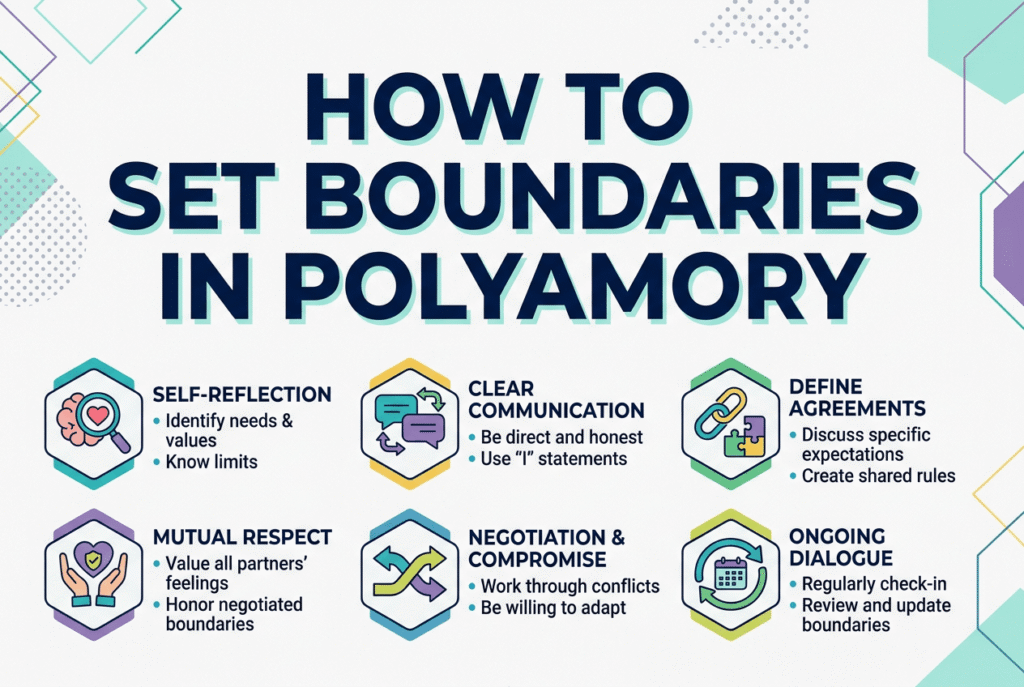
That means slowing down long enough to ask yourself:
- Self-reflection
- Take time to reflect on what’s important to you in your relationships.
- How much time do you need for yourself?
- What kind of communication helps you feel secure?
- What are your emotional triggers?
- Take time to reflect on what’s important to you in your relationships.
- Clear communication
- Have an honest, loving conversation with your partner(s) about your needs, wants, expectations, and desires. Try to approach the conversation from a place of curiosity rather than judgment. It’s not about making demands but about creating a foundation for mutual respect.
- You’ll often hear in the polyamorous community the phrase “Communication, Communication, Communication.” And that’s because it’s ABSOLUTELY essential.
- Define Agreements
- Boundaries should be agreed upon by everyone involved. These agreements can cover various topics such as time management, physical intimacy, emotional care, and more.
- Each partner’s input is vital, so ensure that everyone feels heard and valued in the process.
- Negotiation and Compromise
- Relationships evolve, and so do boundaries. Be open to revisiting and adjusting them as needed. Life circumstances change, and what worked in the past may no longer serve your relationships.
- Mutual Respect
- Once boundaries are set, it’s essential to honor them. Respecting your partner’s and or meta’s boundaries helps build trust and security, making space for love and connection to flourish.
- Ongoing Dialogue
- There needs to be regular check-ins with all partners to see if the boundaries that are currently in place are still needing to stay in place.
- Review and update, remove, or add boundaries. Some people do this every month, three months, six months, or annually. I suggest at the beginning of a new relationship, you should start off no longer than every three months.
Boundaries vs Rules in Polyamory
This is where things can get confusing, because boundaries and rules can sound really similar at first, but they come from completely different places and they feel very different in practice.
rule [rool]/ rul
noun: a principle or regulation governing conduct, action, procedure, arrangement, etc..
Example: “You’re not allowed to have sleepovers with other partners.”
A rule is usually about controlling someone else’s behavior, even when it’s coming from a place of fear, insecurity, or just trying to protect yourself from getting hurt. And honestly, that’s understandable, because polyamory can bring up a lot of vulnerable feelings, and sometimes our first instinct is to try to manage the situation by managing the other person.
The problem is, rules tend to put pressure on the relationship instead of strengthening it, because they ask your partner to shrink themselves or limit their choices in order to keep you comfortable, which usually leads to resentment on one side and anxiety on the other.
boundary [boun-duh-ree, -dree]/ ˈbaʊn də ri, -dri /
noun (plural boundaries): a limit that separates acceptable behavior from unacceptable behavior.
Example: “I’m not comfortable with sleepovers right now, and I need some reassurance and conversation before I feel okay with that.”
A boundary, on the other hand, is about taking care of yourself and being honest about what you need in order to feel okay. It’s less about telling someone what they can or can’t do, and more about explaining what works for you and what doesn’t. Boundaries acknowledge that the other person has their own autonomy, while still making space for your needs to be respected and considered.
Another way to look at it is this. Rules tend to sound like, “You can’t,” or “You have to.” Boundaries tend to sound like, “I need,” or “I’m not okay with.” That shift from focusing on the other person to focusing on yourself is what makes boundaries feel less controlling and more collaborative.
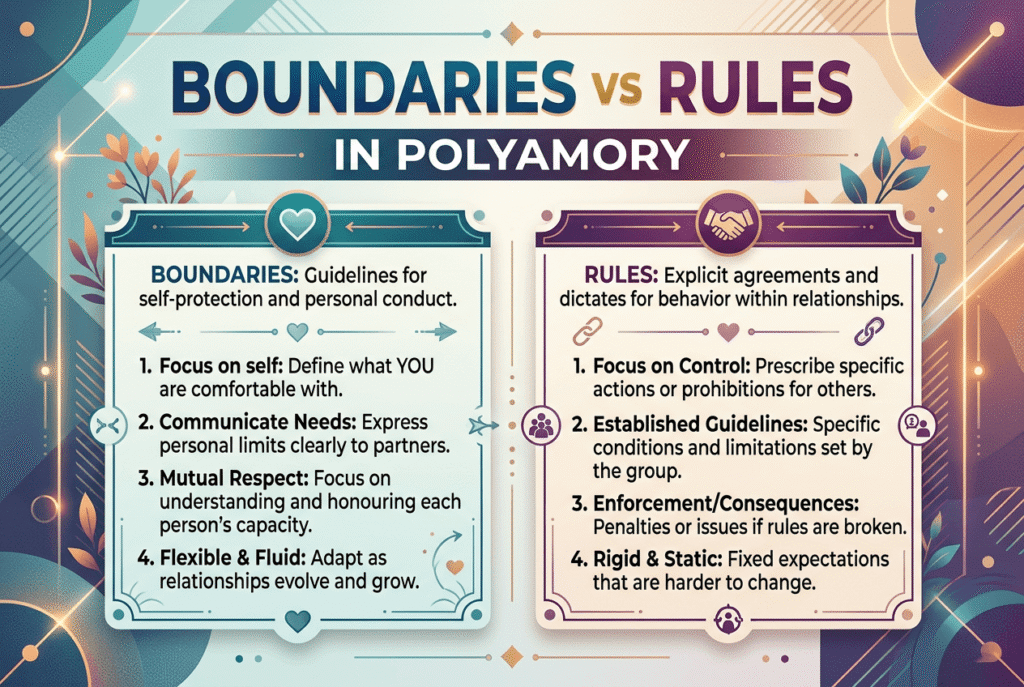
That difference might seem small, but it changes everything about how the relationship feels. Boundaries create space for understanding. Rules tend to create resistance. This is where a lot of confusion happens, because boundaries and rules can look really similar on the surface, but they come from completely different places and create very different dynamics in relationships.
And here’s the part that’s easy to miss. Boundaries also require you to be willing to follow through on your own end. If your boundary is that you need more communication before you’re comfortable with something, then part of holding that boundary is being honest if it’s still not working for you, instead of silently going along with it and hoping the feelings go away. That’s where a lot of people get stuck, because setting the boundary is one thing, but actually honoring it within yourself is another.
Polyamory boundaries can show up in a lot of different areas of your relationship, and once you start paying attention, you’ll probably notice you already have some — you just haven’t said them out loud yet.
Some of the most common areas include:
- Time and Attention (how you balance multiple partners without anyone feeling pushed aside)
- Communication (how often you check in, what gets shared, what feels like too little or too much)
- Emotional Needs (how you handle reassurance, insecurity, or feeling disconnected)
- Physical and Sexual Boundaries (comfort levels, safety practices, consent conversations)
While polyamory allows for deep and varied connections, it’s essential not to lose sight of your relationship with yourself. Self-care plays a crucial role in maintaining healthy poly relationships. Make sure you have time for your own emotional and physical well-being, and that you’re regularly checking in with yourself. This helps prevent burnout and ensures that you’re coming into your relationships from a place of fullness, rather than depletion.
None of these are “too much.” They’re just part of being honest about what you need to feel secure. If at any point you are made to feel like your boundaries are “too much” there needs to be a talk between you and your partner as to why they feel that way and a deeper look into if that relationship is going to be healthy.
A Quick Note on Hierarchy and Boundaries
This is one of those topics that can get really opinion-heavy really fast, so I’m just going to share how I personally see it without trying to tell anyone how they should structure their relationships.
I do understand and agree to a certain level of natural hierarchy when it comes to nesting partners or spouses (also known as couple’s privilege), because when you live with someone, share finances, or build a life together in that way, there’s already a level of entanglement that’s just going to affect time, energy, and availability whether you label it or not. I’ve had this conversation with my own nesting partner, especially since we recently opened from mono on his side to poly on mine, and it was important for me to acknowledge that reality instead of pretending everything exists on a perfectly equal playing field.
That being said, outside of those practical, day-to-day factors, I personally don’t believe in strict hierarchical structures where one relationship is automatically more important or has more say than others just because of a label. But that’s my perspective, and I don’t think it’s something that should be pushed onto anyone else.
Every relationship is different. Every person is different. Every situation comes with its own dynamics, needs, and agreements. What works really well for one polycule might feel completely wrong for another, and that doesn’t make either one of them wrong.
At the end of the day, this is where boundaries and agreements matter more than labels. It’s less about whether something is “hierarchical” or “non-hierarchical,” and more about whether everyone involved feels respected, informed, and genuinely considered in how those dynamics play out.
Remember above when I mentioned about the property boundary stakes?
So think of boundaries in polyamory, or honestly any relationship, as being similar to those stakes people put in the ground to create an invisible property line. It’s not just so you know where your yard ends. It’s so your neighbor knows where your property starts too. And we all know what it’s called when someone steps over that line onto your property without permission. Trespassing. The same thing applies when a partner crosses your invisible boundary line, whether they meant to or not.
Now here’s where the kickball comes in, because this is the part people don’t always think about.
We all know that sometimes a kickball ends up rolling across the property line into the neighbor’s yard. It happens. Nobody threw it over there on purpose, it just went that direction. But you still go pick it up and bring it back. You don’t just leave it there and pretend it didn’t happen.
That kickball is your boundary being crossed. Maybe it was something small. Maybe it was something that really stung. Maybe your partner didn’t even realize they did it. But it still crossed the line, and that matters regardless of the size of it or the intention behind it.
Here’s the part that’s really important though, and it’s something a lot of people get backwards.
It is your responsibility to speak up and address the fact that your boundary was crossed. Not in a dramatic way, not as an attack, but just honestly saying, “Hey, that crossed a line for me and I need us to talk about it.” That part is on you.
And then it becomes the responsibility of the person who crossed it to actually hear you, take it seriously, and correct themselves going forward.
Both parts matter. You can’t just silently keep score and expect things to get better. And the person who crossed the boundary can’t just brush it off or make you feel like you’re overreacting for bringing it up.
That’s how boundaries in polyamory actually work in real life. Not perfectly. Not without the occasional kickball moment. But with enough honesty and accountability on both sides to keep things from turning into something bigger than they need to be.
Additional Resources to Explore Polyamory and Boundaries
Want to dive deeper into the art of polyamory and boundary-setting? Below are some resources from trusted voices in the polyamorous and ethical non-monogamy communities. All of these are resources that I have personally read or found helpful.

Reading Materials about Polyamory Boundaries & Communication
More Than Two, Second Edition:
Cultivating Non-monogamous Relationships with Kindness and Integrity (Eve’s Version)
by Eve Rickert and Andrea Zanin
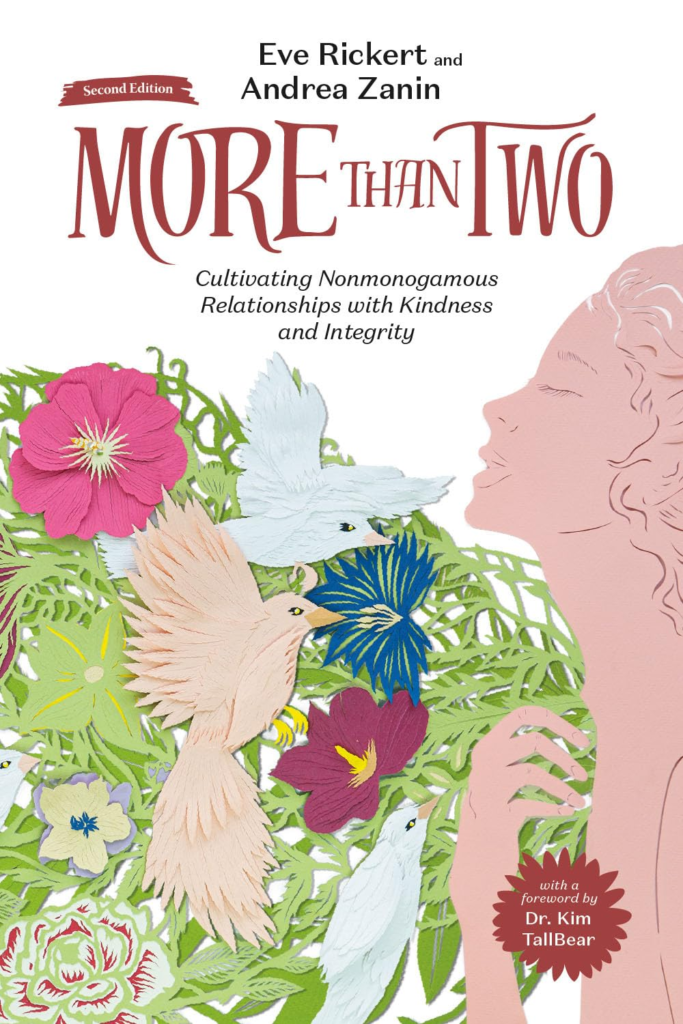
More Than Two, Second Edition, can’t promise outcomes, but it is a guide to the paths—from anchor or nesting partnerships to relationship anarchy—possible within nonmonogamy. Drawing on the best of its predecessor while completely reimagining its approach, this entirely new work bridges emerging theories on attachment and relationship diversity. The arcs of non-monogamous partnerships bend towards complexity, introspection and compromise, or at least they can, if we work at it.
*Note* The first edition book did have some controversy which involves accusations of emotional abuse and manipulation against co-author Franklin Veaux by several former partners, including co-author Eve Rickert, who came forward in 2019-2020. Critics and survivors argue that the book’s, “More Than Two: A Practical Guide to Polyamory,” advice was used to justify abusive behaviors, such as pathologizing partners’ feelings.

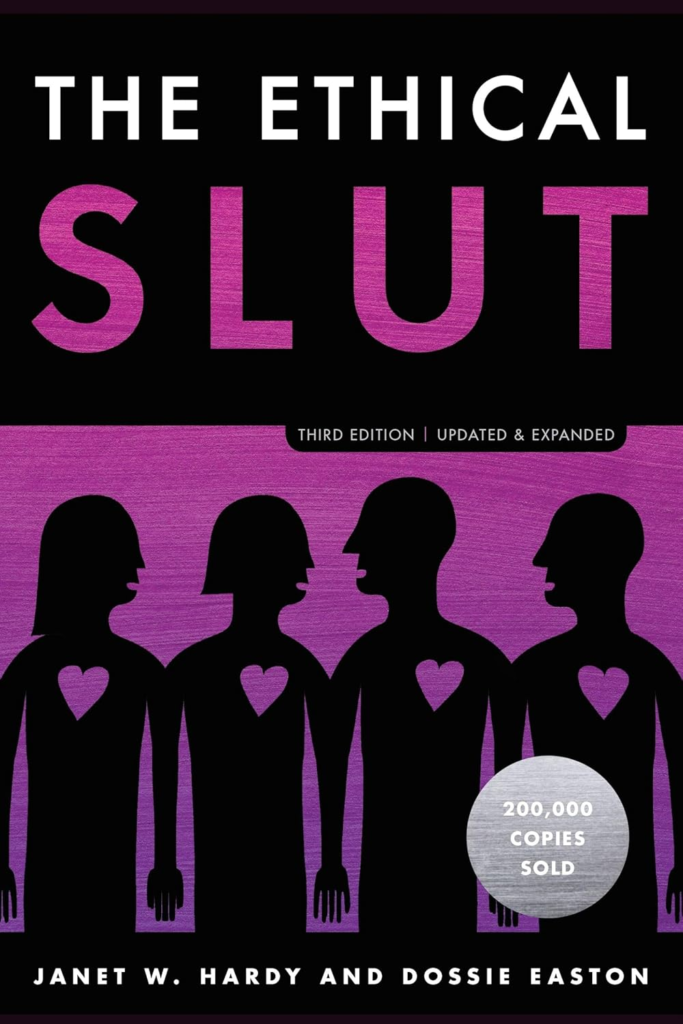
The Ethical Slut, Third Edition:
A Practical Guide to Polyamory, Open Relationships, and Other Freedoms in Sex and Love
by Dossie Easton and Janet W. Hardy
The classic guide to love, sex, and intimacy beyond the limits of conventional monogamy has been fully updated to reflect today’s modern attitudes and the latest information on nontraditional relationships.
For 20 years The Ethical Slut has dispelled myths and showed curious readers how to maintain a successful polyamorous lifestyle through open communication, emotional honesty, and safer sex practices.
The third edition of this timeless guide to the ethics of relationships, communication, and sex has been revised to include:
- New sidebars on topics such as asexuality, sex workers, LGBTQ terminology, and ways polys can connect and thrive
- Interviews with poly millennials
- Tributes to polyamory pioneers
- Tools for conflict resolution and instructions on how to improve interpersonal dynamics
Polysecure:
Attachment, Trauma, and Consensual Nonmonogamy by Jessica Fern
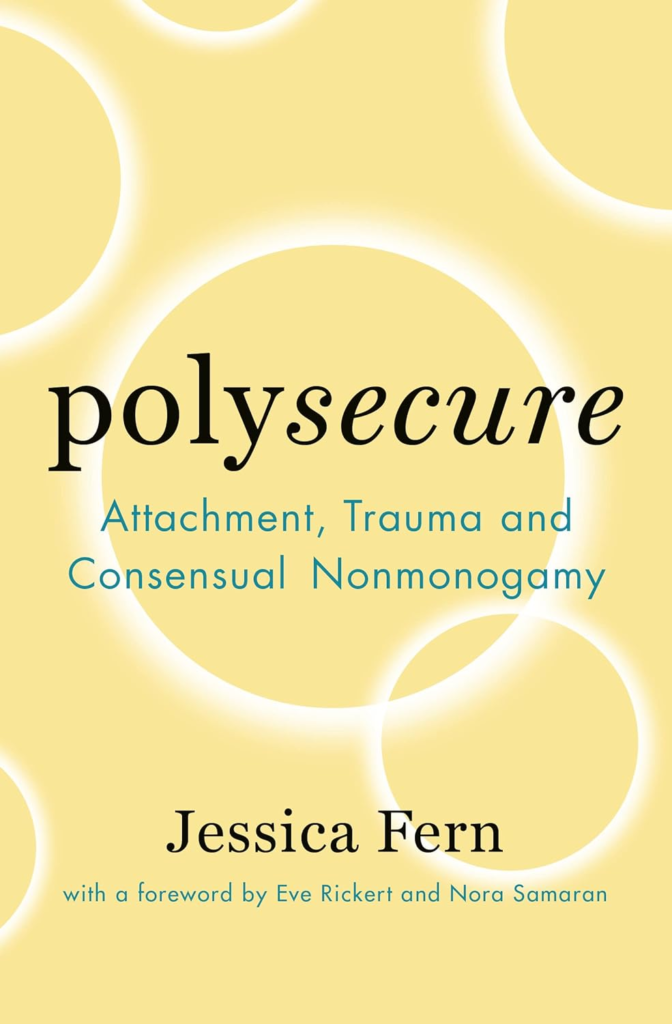
Attachment theory has entered the mainstream, but most discussions focus on how we can cultivate secure monogamous relationships. What if, like many people, you’re striving for secure, happy attachments with more than one partner?
Polyamorous psychotherapist Jessica Fern breaks new ground by extending attachment theory into the realm of consensual nonmonogamy. Using her nested model of attachment and trauma, she expands our understanding of how emotional experiences can influence our relationships. Then, she sets out six specific strategies to help you move toward secure attachments in your multiple relationships. Polysecure is both a trailblazing theoretical treatise and a practical guide.
My one partner & meta have this book and we’ve already read through it once, we’re reading it again since our polycule has grown.
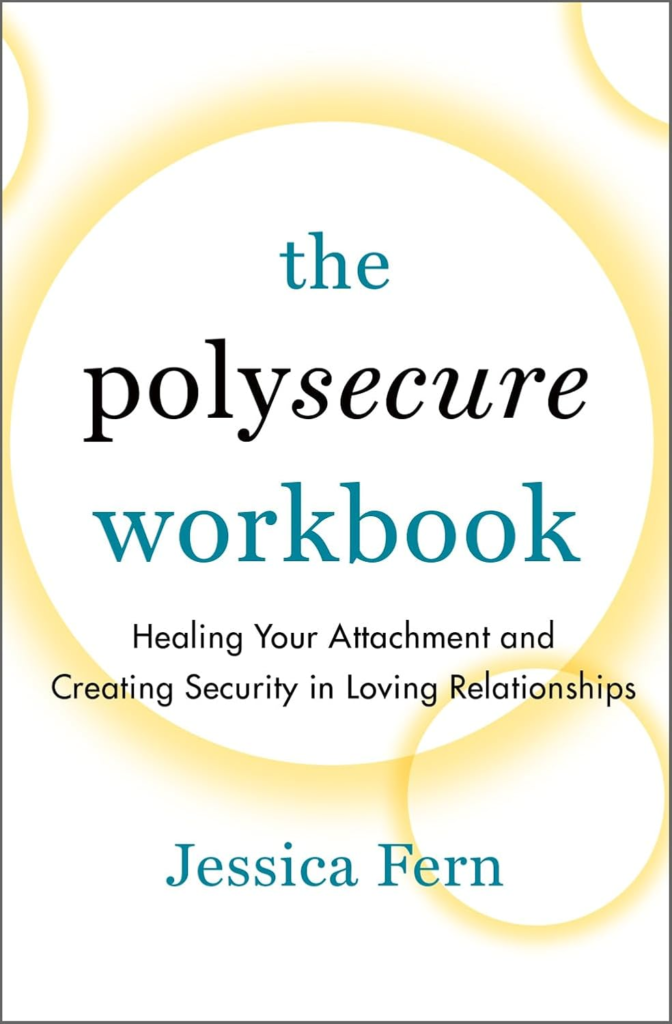
The Polysecure Workbook:
Healing Your Attachment and Creating Security in Loving Relationships by Jessica Fern
The Polysecure Workbook encourages examination of any attachment challenges you may have experienced in your opening up process and offers insights into how to build secure relationships.
Through practical exercises, you will explore your own attachment history, examine your reasons for practicing nonmonogamy and the different styles of nonmonogamy that you relate to, and consider whether you rely on relationship structure for your attachment security. The Polysecure Workbook provides the tools needed to navigate the complexities of multiple loving relationships and to build personal security.
My one partner & meta have this workbook and we’ve been working through it. Think of it sort of the “shadow workbook/journal” of the ENM lifestyle.
Mono in a Poly World:
What to Do When Your Partner Is Polyamorous and You Aren’t by Tazmyn Ozga

What do you do when your partner is polyamorous and you aren’t?
This is the question author Tazmyn Ozga began to ask herself in 2015 when, after 25 years of a monogamous marriage, her husband declared his need to be polyamorous and free to have multiple relationships. Their decision to stay together and try to make it work began her journey of learning about polyamory through reading and research, and life experiences and lessons.
Mono in a Poly World is a guidebook and resource for those navigating the path of monogamous-polyamorous relationships. This book covers the basics of polyamory as well as the issues that make mono-poly relationships unique and challenging. Additionally, best practices and worst practices in consensual non-monogamy are explored, providing a roadmap for healthy relationships with compromises that can meet the needs of both partners.
While Mono in a Poly World is written from a monogamous perspective, a polyamorous partner can also read and learn how to better navigate this special dynamic. The goal is mutual: loving partners happy together, despite their differences.
Podcasts about Polyamory Boundaries & Communication
Polyamory Weekly – A fantastic podcast covering a variety of polyamory topics, including emotional management, boundaries, and relationship agreements.
Loving Without Boundaries – This blog and podcast offer a wealth of information on polyamorous relationships, including guidance on creating healthy boundaries.
Multiamory – One of the most widely recommended shows, focusing on practical, science-based tools for modern relationships, polyamory, and ENM.
Normalizing Non-Monogamy: Hosted by married couple Emma and Fin, this show features weekly interviews with people across the entire spectrum of ENM and swinging.
Nope! We’re Not Monogamous: Hosted by non-monogamy coach Ellecia Paine, this show tackles the hidden costs of ignoring jealousy, social scrutiny, and relationship anxiety.
Polycurious: A great resource for navigating polyamory, dating dynamics, and emotional de-escalation. Explore their catalog on Polycurious
Websites about Polyamory Boundaries & Communication
Making Polyamory Work: Hosted by relationship expert Kathy Labriola, this site offers practical advice on how to communicate effectively, tackle common pitfalls, and set boundaries rather than coercing partners
Non-Monogamy Help: This resource directly tackles the difference between rules and boundaries. It features episodes and articles designed to help you figure out what to do when your boundaries are crossed
Ready For Polyamory: A comprehensive educational blog that focuses on relationship infrastructure, emotional ergonomics, and safely navigating agreements between multiple partners.
#Open: A multimedia blog and dating app project centering non-monogamy, polyamory, and non-traditional relationships.




One Comment